Everybody goes home.
That sentence is the entire program. Everything below is just the machinery that makes it true on a Tuesday in the rain with the schedule slipping.
- TRIR
- 0.61
- DART
- 0.28
- EMR
- 0.74
- Stop-work calls
- 214
01 Stop-work authority
Any employee. Any job. No permission required.
A first-week laborer can shut down a maxi-rig crossing if something looks wrong, and nobody at Rock Ridge is allowed to ask them to justify it first. The job stops, the crew talks it through, and it does not restart until the person who called it agrees.
We track the calls, not the injuries. Injury counts tell you what already went wrong. Stop-work calls tell you whether people still believe the policy is real. We had 214 of them last year, and we publish that number internally every month next to production.
No employee has ever been disciplined, reassigned, or scheduled differently for making a stop-work call. If that ever changes, the program is over and everyone will know it within a week.
What happens after a stop-work call
The foreman documents the condition, the crew re-runs the hazard analysis with the change, and the superintendent is notified the same day. If the fix costs money or time, that is a Rock Ridge problem, not the caller's.
| Metric | Value | Definition |
|---|---|---|
| TRIR | 0.61 | Total recordable incident rate. NAICS 237130 average is 2.3. |
| DART | 0.28 | Days away, restricted, or transferred. |
| EMR | 0.74 | Experience modification rate, current policy year. |
| Stop-work | 214 | Crew-initiated stops in the trailing twelve months. |
Where the program comes from
Common Ground Alliance member — damage prevention written to CGA Best Practices, damages reported to DIRT · NUCA member — trench safety curriculum and the annual Trench Safety Stand Down · Veriforce operator qualification · ISNetworld grade A · Avetta compliant · NCCCO certified operators.
02 Damage prevention
The one-call sequence, run as production work.
Our damage prevention program is written against the Common Ground Alliance Best Practices, not against a generic safety manual. The crews are trained on it in those terms.
Pre-mark
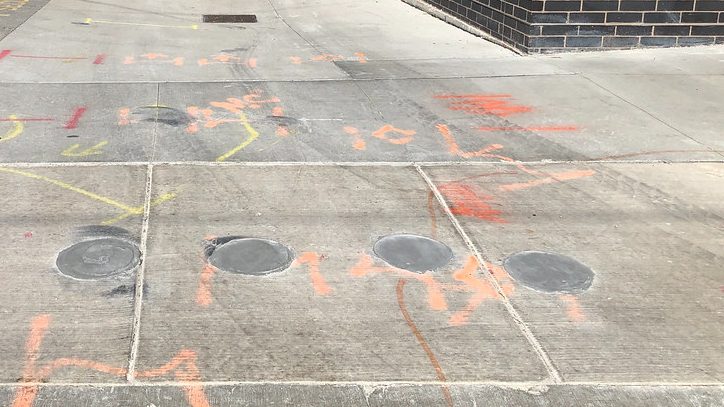
White-line the proposed excavation before the ticket is filed, so the locator marks the ground we are actually going to open — not the whole block.
Notify
811 ticket filed with the correct dig window, scope, and limits. Filed by a person who has seen the site, not copied from the last ticket.
Positive response
Full statutory wait, then confirmed positive response from every operator on the ticket. No verbal releases, no "the marks are probably fine."
Verify
Marks photographed and reconciled against operator records and our own SUE data. A mark that disagrees with the record stops the job until it is resolved.
Expose
Vacuum excavation opens every facility inside the tolerance zone. Depth, offset, size, and material recorded at each test hole.
Excavate & record
Soft dig inside the tolerance zone, spotter on any machine working near a marked facility, then photos and GNSS points carried into the as-built.
Result, and what we do with it
99.2 percent of tickets closed with no facility damage over the last twelve months. Every damage — all of them — gets a root cause review inside 48 hours, is submitted to the CGA's Damage Information Reporting Tool with an honest root cause, and the finding goes out to every crew in the company whether it flatters us or not. Submitting a clean-looking DIRT record helps nobody.
Report a damage or a near miss
Anyone, including the public and other contractors, can report a facility damage or an unsafe condition on one of our sites at 1-800-555-0199, staffed around the clock. Anonymous reports are accepted and investigated the same way.
03 Training & qualification
Nobody works a task they are not current on.
Qualification records expire loudly. An expired card means the person does not perform the task that day, and dispatch sees it before the crew leaves the yard.
| Program | Who | Frequency | Verified by |
|---|---|---|---|
| New hire orientation & field mentorship | All field employees | On hire + 90 days | Safety department |
| CGA Best Practices — damage prevention | All field employees | On hire, annual refresh | Internal, CGA curriculum |
| Excavation competent person | Foremen & superintendents | Annual | Third party |
| NUCA trench safety & annual Stand Down | All excavation crews | Annual, June | NUCA curriculum |
| Confined space entry & rescue | Water, sewer & vault crews | Annual | Third party |
| Operator qualification, covered tasks | Gas division personnel | Per task interval | Veriforce, ASME B31Q |
| Qualified electrical worker to 34.5kV | Line crews | Annual | Utility & internal |
| HDD operations & inadvertent return response | Drill crews | Annual + per crossing | Internal, drill OEM |
| Flagging & temporary traffic control | All field employees | 2 years | ATSSA curriculum |
| Roadway worker protection — Class I railroad | Crews on railroad property | Annual | Host railroad |
| CDL & motor carrier compliance | Drivers | Per FMCSA | Fleet department |
| Daily job hazard analysis | Every crew, every job | Daily, at the tailboard | Foreman + crew signature |
04 Documentation
What the work is written against.
Procedures cite the standard they came from. When an owner's auditor asks why we do something a particular way, the answer is a document and a section number, not a preference.
- Damage prevention
- Common Ground Alliance Best Practices. Our field procedures are cross-referenced to CGA practice numbers, and damages are submitted to the CGA Damage Information Reporting Tool with an honest root cause.
- Excavation & trench safety
- NUCA trench safety curriculum, competent-person program, and participation in the annual Trench Safety Stand Down every June.
- Subsurface utility engineering
- ASCE 38-22, quality levels QL-D through QL-A. Every deliverable states the quality level achieved, per feature.
- Utility records
- ASCE 75-22 for recording and exchanging as-built utility data, mapped to the owner's own GIS schema.
- Gas distribution
- 49 CFR Part 192, operator qualification under Subpart N, covered tasks per ASME B31Q, and the operator's own DIMP.
- Electric distribution
- NESC clearances and construction grades, plus the host utility's construction standards, which always govern where they are stricter.
- Water & wastewater
- AWWA C600 installation and testing, C651 disinfection, ASTM F1216 for cured-in-place lining, NASSCO PACP coding for condition assessment.
- Directional drilling
- ASTM F1962 for pullback and profile design, with a written inadvertent-return contingency plan on site before the pilot bore spuds.
Why CGA and not a generic manual
The Common Ground Alliance Best Practices are the only damage prevention document in this industry written by every party at the table — operators, locators, excavators, one-call centers, and regulators. Writing our procedures to a standard the utility we are digging next to already recognizes removes an entire category of argument from the job site.
DIRT, honestly
Reporting a damage costs us nothing and helps the next contractor. Under-reporting it protects a number and gets somebody hurt two counties over. We submit every one.
05 Commitments
What we owe the people on the crew.
The plan before the work
Every crew starts the day with a hazard analysis they built themselves and signed. No pre-printed form filled out in the truck.
The right tool on site
If the job needs a vac truck, a trench box, or a bucket, it shows up. Nobody improvises around missing equipment.
Honest incident review
Root cause, not blame assignment. Findings are shared company-wide, including the ones that make management look bad.
Rest that is real
Hour limits on storm and night work are enforced by dispatch, not left to the crew that wants the overtime.
Heat, cold, and weather calls
Written thresholds for heat index, lightning, and wind. The foreman does not have to argue with an office for a weather stand-down.
A way to speak up
Anonymous reporting line, a safety committee with elected craft members, and a superintendent whose number every crew has.
06 Next step
Ask us for the whole file.
Safety manual table of contents, three years of recordable incident summaries, EMR letter, our CGA Best Practice conformance matrix, and the incident review process.
If you take one thing from this page
Call 811 before you dig. It is free, it is the law in every state we work in, and it prevents more harm than any other single thing in this industry.